Conversational AI Platform: Features, Benefits & How to Choose
.jpeg)


A conversational AI platform is enterprise software that combines natural language understanding, large language models, and generative AI to build, deploy, and manage AI agents that resolve customer conversations across web chat, voice, messaging apps, and email, at scale.
A customer in Rotterdam opens your web chat at 22:40 to ask where her parcel is. She wants a tracking number and a delivery date, in Dutch, now. Tomorrow morning a customer in Helsinki asks the same thing in Finnish, and a third asks it by phone in German. A conversational AI platform is the software that answers all three from one place: it holds the language models, the connection to your order system, the rules about what the AI may and may not say, the channels it runs on, and the handover to your team when a person is needed.
The word "platform" is doing real work in that phrase. A chatbot is one thing a customer sees. A platform is the system behind it: the AI engine, the knowledge base, channel deployment, integrations, analytics, and human escalation held together in one place, with versioning and access control around them. That difference matters because support volume keeps rising while support headcount does not. Gartner found that 91% of service and support leaders are under pressure from executive leadership to implement AI, from a survey of 321 leaders, and most of those organisations are redesigning the agent role instead of cutting it. This guide covers what a conversational AI platform is, how one works, the features to look for, the main use cases, the benefits, how to evaluate vendors, how to implement, and where Kindly fits for European B2C support teams.
What is a conversational AI platform?
A conversational AI platform is enterprise software that powers human-like, multi-turn conversations between a brand and its customers across digital and voice channels. It combines natural language understanding, machine learning, large language models, and generative AI in one managed system, so a support team can build, train, deploy, and govern AI agents without assembling half a dozen separate tools.
Buyers who search for what is conversational AI platform software want one thing explained first: where the platform ends and the chatbot begins. A chatbot is the end product your customer talks to. The platform is the system that builds, runs, measures, and improves that chatbot, and every other conversational interface your business operates, from one set of controls. Buy a tool and you get one agent live. Buy a platform and you get the means to run twenty of them across six markets with one team.
What changed in the past few years is what the software can do once it understands the question. Early systems matched keywords and followed decision trees. Current platforms combine retrieval-augmented generation, agentic workflows, and connections into the CRM and order management system, so the AI can resolve the contact instead of routing it. For a brand turning over EUR 30 million or more and handling 100,000 or more support contacts a year in five languages, that difference decides whether automation holds at peak or collapses into a queue.
Conversational AI platform vs chatbot
A chatbot is one output of a conversational AI chatbot platform. The platform is the system that builds, governs, and scales chatbots, voice agents, and AI agents across the business. Two gaps separate them, and the same gaps separate a generative AI product from a managed system, which is a different question again and one we cover in our piece on generative AI vs conversational AI.
- The capability gap. A rule-based chatbot matches keywords and walks a decision tree, so a customer who phrases a question the way the script expects gets an answer and everyone else gets a dead end. A platform uses natural language understanding, machine learning, and large language models to read free-form language, carry context across several turns, and cope when the same intent arrives spelled three different ways.
- The production gap. A chatbot tool gets one agent live. A platform gives you versioning, A/B testing, separate build and production environments, role-based access, audit trails, and analytics on what the AI resolved. At a few hundred conversations a month you can manage without those. At 100,000 contacts a year you cannot.
How a conversational AI platform works
When a customer sends a message, the platform runs it through six stages before anything reaches the customer. The stages are the same whether the message arrives by web chat at midnight or by phone on a Tuesday afternoon, and most of the work happens in under two seconds.
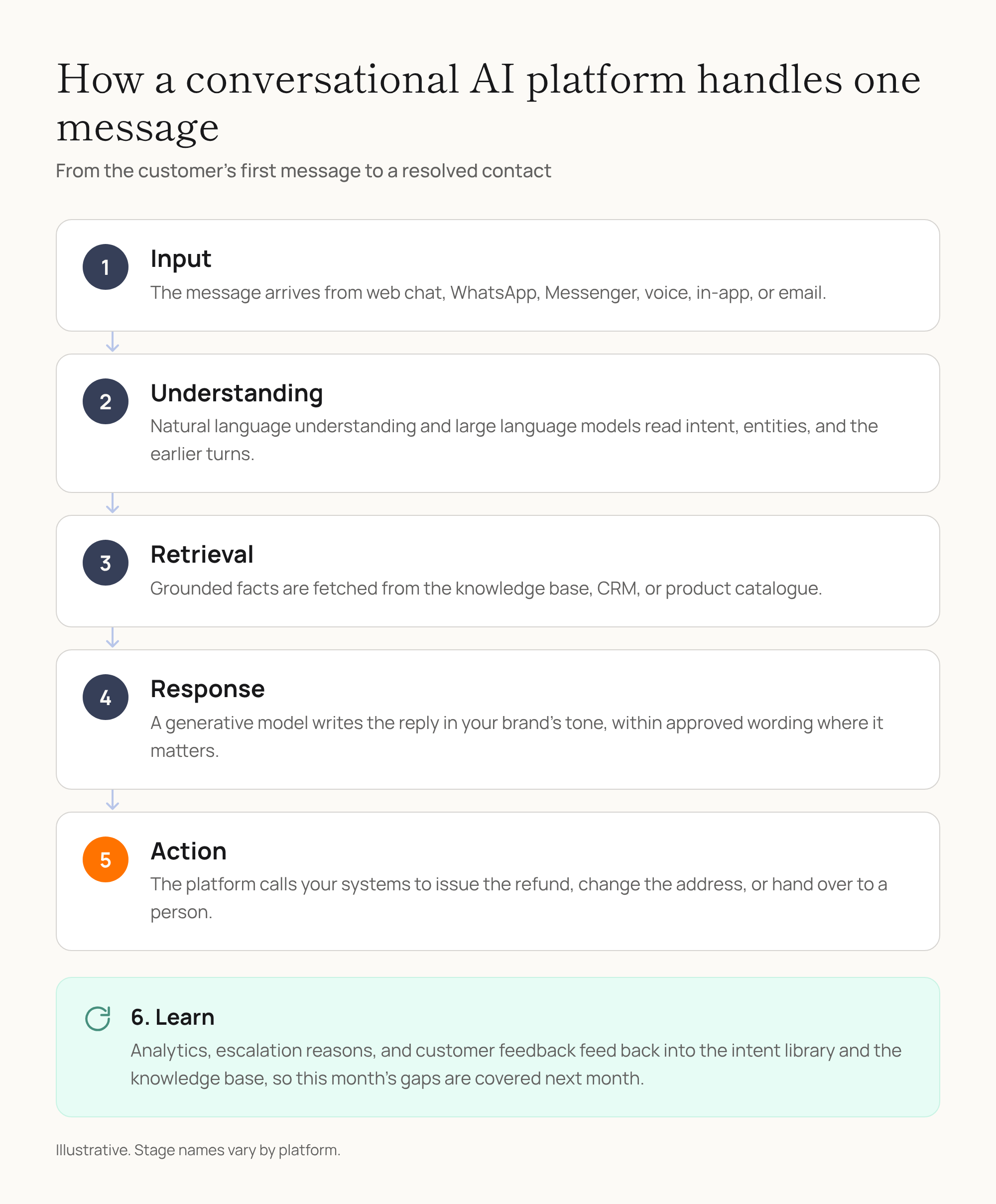
- Input. The platform receives the message from whichever channel the customer used: web chat, WhatsApp, Messenger, voice, in-app, or email.
- Understanding. Natural language understanding and large language models read the intent, pull out entities such as an order number or a date, and take account of what the customer said in earlier turns.
- Retrieval. The system fetches grounded information from a connected knowledge base, CRM, or product catalogue using retrieval-augmented generation, so the answer comes from your content and not from the model's memory.
- Response generation. A generative model writes a reply in your brand's tone. For compliance-sensitive topics such as refunds or account changes, teams restrict the agent to approved wording instead.
- Action. The platform calls your systems to do the thing the customer asked for: issue the refund, change the delivery address, reschedule the slot, or hand the conversation to a person with the context attached.
- Learn. Analytics, escalation reasons, and customer feedback go back into the intent library and the knowledge base, so the gaps the agent hit this month are covered next month.
Features of a conversational AI platform
When you move from a point tool to conversational AI platform software, you are paying for the parts that keep an automation programme running after launch: governance, analytics, integration depth, and language coverage. The checklist below is what a buyer at a mid-market or enterprise B2C brand should expect to see demonstrated, not described.
- Multi-channel deployment. Build once, run on web chat, WhatsApp, Messenger, voice, in-app, and email.
- Natural language understanding and intent recognition. Reads intent, entities, and context across multi-turn conversations.
- Generative AI grounded in a knowledge base. Answers from your verified content through retrieval-augmented generation, not from the model alone.
- Multilingual support. Handles more than 100 languages with automatic detection.
- CRM, help desk, and ERP integrations. Reads and writes order, ticket, and customer data so the AI can resolve the contact.
- No-code and low-code builder. Lets the support team own the agent without an engineering queue.
- Analytics and reporting. Tracks resolution, deflection, CSAT, and conversion impact, not conversation volume alone.
- Human-in-the-loop escalation. Routes high-stakes or low-confidence conversations to a person with the full transcript.
- Security and governance. GDPR compliance, EU data processing, ISO/IEC 27001 certification, role-based access, audit logging.
Three of those separate a serious platform from a generic tool, and they are the three that demos tend to gloss over. The first is multilingual handling. A vendor that supports a language through machine translation on top of an English model gives you an agent that reads a Finnish question well enough and answers it in stilted Finnish, and your CSAT in Finland tells you so within a fortnight. Native multilingual models read the language itself, which is why Kindly agents handle more than 100 languages without a separate build per market.
The second is knowledge-base grounding, and the third is integration depth. Grounding decides whether the AI invents a returns policy or quotes yours. Integration decides whether it tells the customer how to track a parcel or tracks the parcel. Ask any vendor to show you both against your own content and your own order system during evaluation, because a hand-curated demo dataset will hide a weakness in either one.
Conversational AI platform use cases
The use cases below are where European B2C support teams get the clearest return, ordered by volume. For a wider set of examples across industries, our guide to the best chatbot use cases goes further than this list does.
- Customer support automation. Order status, returns, refunds, password resets, and policy questions make up the bulk of inbound contacts for most consumer brands, and they repeat all year. An AI agent connected to the order system answers them with the customer's actual data. Norwegian, the airline, cut live enquiries to agents by 20% and now answers one in five enquiries without a person.
- Conversion and cart recovery. A customer hesitating at checkout has a question about delivery cost, sizing, or returns. An agent that answers it in the moment keeps the order. This sits closer to conversion strategy marketing than to support, and it is the part of the business case a deflection-only tool cannot make.
- Cross-border multilingual support. One platform serves a Finnish customer in Finnish and a Dutch customer in Dutch, from the same build and the same knowledge base. Markets you could not justify staffing get the same service hours as the markets you can.
- Voice and contact centre deflection. Phone remains the channel customers reach for when something has gone wrong. A voice agent handles routine calls outright and pre-qualifies the rest, so the person who picks up already knows the order number and the problem.
- Sales and lead qualification. On high-consideration products, a visitor comparing two models will ask a question instead of reading a spec sheet. The agent answers, recommends, and passes the qualified lead to sales with the conversation attached.
- Internal employee support. HR, IT, and operations questions run on the same platform as the customer-facing agents, which means one set of integrations, one governance model, and one team maintaining both.
Benefits of a conversational AI platform for European B2C brands
The business case for European mid-market and enterprise brands rests on four things: margin per resolution, revenue recovered during the purchase, service levels in markets too small to staff, and a compliance position the legal team signs off without a six-week review. Here is how those translate at 100,000 or more contacts a year across several languages.
- Round-the-clock multilingual coverage. Customers in Norway, Sweden, Denmark, Finland, the Netherlands, and Germany get answers in their own language at the hour they ask, without a regional team in each market. Smaller markets stop being the ones where service quality drops first.
- Lower cost per resolution. The repeat questions that make up most of your volume move to the AI agent, and the people you employ spend their time on complaints, exceptions, and the conversations where empathy changes the outcome.
- Conversion and revenue lift. An agent working during the purchase answers the question that was about to end the session. That revenue shows up as orders completed, not as tickets avoided.
- Faster responses, and the CSAT that follows. Customers rate speed and accuracy above almost everything else, and a platform delivers both at two in the morning and during a Black Friday peak.
- Consistency across channels and markets. Tone, escalation rules, and approved content are governed from one place, so the answer on WhatsApp in Danish matches the answer on web chat in German.
- GDPR and EU data processing. Kindly processes and stores authentication, conversation, and platform data in EU data centres, and offers an all-EU configuration for generative AI on request. For brands operating in Germany, the Netherlands, Luxembourg, and the Nordic markets, that shortens the procurement review.
- Scale without matching headcount. Seasonal peaks get absorbed by the platform, so you stop recruiting and training a temporary team for every market every autumn.
How to choose a conversational AI platform
Which conversational AI platform is best depends on what your contacts look like, so start by writing down your top 10 intents, your language mix, your channel split, and the systems the AI will have to read from. Take that document into every demo. Most conversational AI platform providers can answer any question in the abstract, and almost none of them can answer those four against your own data without preparation.
Then run the shortlist against a fixed checklist instead of a sales deck. The questions below predict how the platform behaves in month six, which is when the pilot excitement has gone and the programme either compounds or stalls. Score every vendor on the same list, and insist on seeing each answer demonstrated in the product.
- Generative and structured together. Can one agent combine generative answers for open questions with structured, approved responses for compliance-sensitive topics?
- Knowledge-base grounding. Does it answer from your verified content through retrieval-augmented generation, or from the foundation model, with the hallucination risk that carries?
- Language coverage. Native handling of every language you serve, with automatic detection, and not machine translation bolted onto an English model.
- Integrations. Ready-made connectors for your CRM, help desk, e-commerce platform, and order management system, plus an API for whatever is bespoke.
- Human escalation. A handover that carries the full conversation, so the customer never explains the problem twice.
- Analytics that measure resolution. A deflection chart tells you a ticket was not created. It does not tell you the customer's problem was solved.
- EU data processing and GDPR. Where data is processed and stored, which sub-processors are involved, what transfer mechanisms apply, and which certifications the vendor holds.
- Total cost of ownership. Licence, model usage, implementation services, and the internal time to maintain content. Ask for all four.
- Time to value. Ask for a go-live date and a resolution target in writing. With Kindly, simple use cases go live within a day, and deployments with several integrations or markets take one to three weeks.
Common pitfalls when evaluating conversational AI platforms
Shortlists go wrong in predictable ways, and the pattern is that the evaluation measures the vendor's best case instead of your normal week. Guard against these five.
- Judging the platform on a demo built from a clean, hand-picked dataset that looks nothing like your production content.
- Reading deflection rate as resolution rate. A contact that was deflected and came back twice cost you more than it saved.
- Underestimating how long it takes to clean and structure the knowledge base. This is the work that delays most launches, and it starts before you sign.
- Leaving GDPR and data processing questions for legal to sort out after the decision.
- Assuming a platform built for the US market handles Dutch, Finnish, and Danish as well as it handles English. Test it in your smallest market, not your largest.
How to implement your conversational AI platform
A realistic programme for a brand handling 100,000 or more contacts a year runs in stages, and the first two happen before the AI answers anyone. The brands that reach a high resolution rate fastest are the ones that spent the first fortnight on their own data instead of on configuration.
Expect a single-language, single-channel pilot inside four to eight weeks, and full multi-channel, multi-language production within three to six months. Those figures move with the state of your knowledge base and the number of systems the agent has to reach.
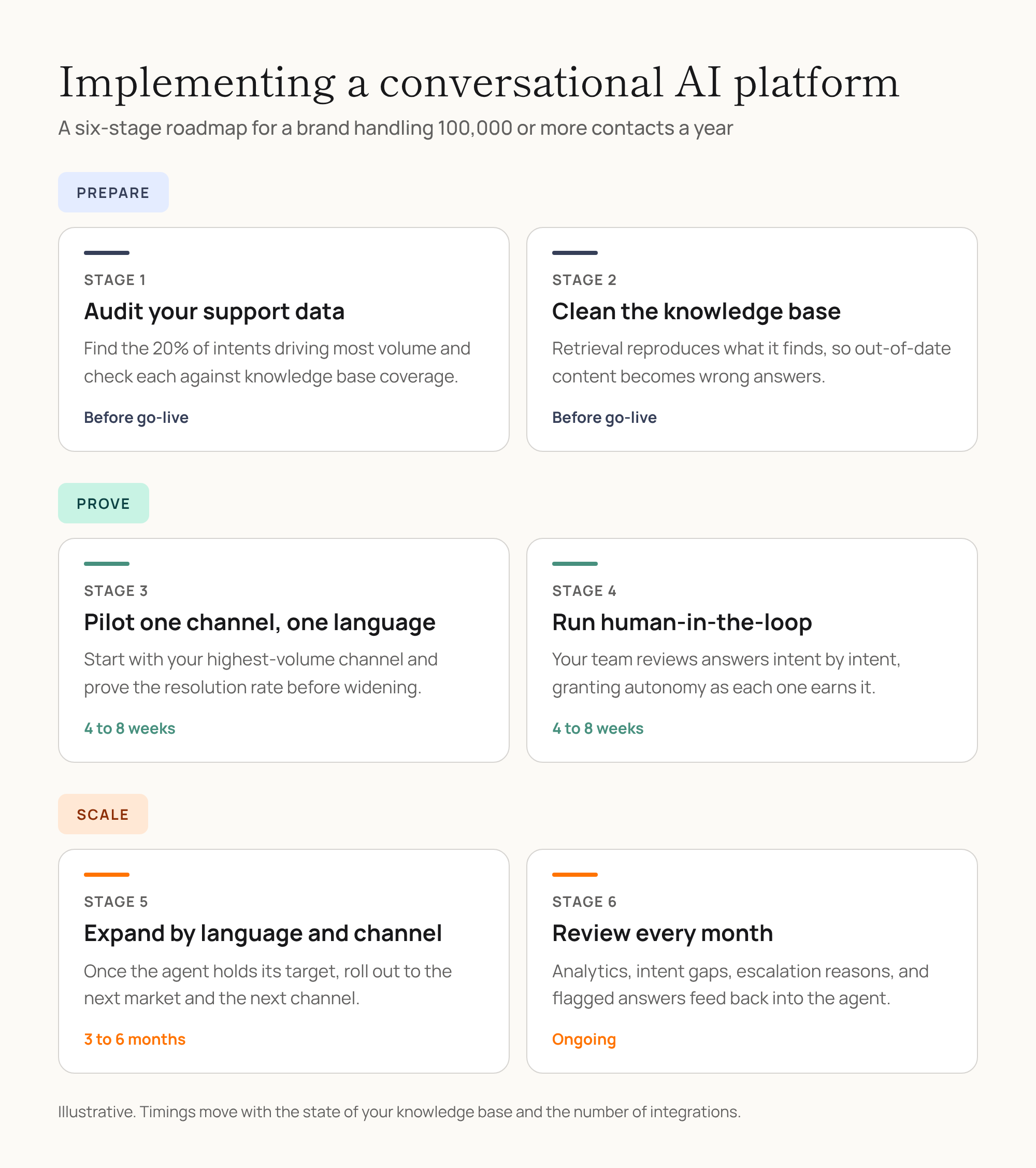
- Audit your support data. Find the 20% of intents that drive most of your volume, and check each against what your knowledge base covers. The gaps are your content backlog.
- Clean and structure the knowledge base. Retrieval-augmented generation reproduces what it finds. Out-of-date delivery times and three versions of the returns policy become three wrong answers.
- Pilot in one channel and one language. Start with the highest-volume channel, which for most B2C brands is web chat, and prove the resolution rate before you widen.
- Run a human-in-the-loop period. Have your team review AI answers for accuracy and tone, intent by intent, and grant autonomy on each one as it earns it.
- Expand by language and channel. Once the agent holds its resolution target, roll out to the next market and the next channel.
- Review every month. Go through analytics, intent gaps, escalation reasons, and flagged answers, and feed what you find back into the agent.
How Kindly compares as a conversational AI platform for European B2C
Search for the best conversational AI platform and you get lists of US-built generalists designed to serve every market, every industry, and every use case. That breadth is the problem for a European B2C brand running 100,000 contacts across five languages. A platform built to be adequate everywhere tends to be excellent at nothing that decides your outcome: native language quality in markets of five million people, EU data processing your legal team accepts without a negotiation, engagement during the purchase as well as after it, and analytics that report resolution instead of avoidance.
Kindly is built for that situation. The Kindly Platform is an ai conversational platform for consumer-facing brands in retail, e-commerce, travel, and consumer services across Europe, and the differences show up where European buyers press hardest. Agents handle more than 100 languages with automatic detection, so a Finnish customer and a Dutch customer are served from the same build. Kindly processes and stores authentication, conversation, and platform data in EU data centres, and offers an all-EU configuration for generative AI on request, backed by ISO/IEC 27001:2022 certification. Kindly GPT combines machine learning with generative answers grounded in your own knowledge base, so replies stay conversational without inventing policy, which is what makes this an enterprise conversational AI platform and not a model with a chat window. Kindly Chat carries the human side: when a conversation exceeds the agent's confidence threshold, a live agent takes over with the full transcript in front of them. Teams report 70% fewer hours spent on maintenance once the agent is running.
Norwegian's numbers show what that adds up to. The airline carried 23 million passengers in 2025 with around 1,000 people in customer service, and its Kindly agent now answers one in five enquiries without a person, cutting live chats by 30% and incoming calls by 5%. Those are support figures, and the commercial side moves too, because an agent that engages customers during the purchase affects orders as well as tickets. If you want to know what your own contact volume and language mix would produce, that is a conversation worth having with your data in front of you.
The future of conversational AI platforms: agentic AI and beyond
The category is moving from software you talk to towards software that completes the task. Five shifts are driving that, and the first is already in production at brands that started early.
- From conversational AI to agentic AI. Agents are being given the ability to run multi-step work across the CRM, order management, and payment systems, so a refund request ends in a refund and not in a ticket.
- Voice as a standard channel. Real-time speech models have improved to the point where voice is part of the platform and not a separate product with a separate build.
- Personalisation from history, not session. Answers grounded in everything the customer has bought, returned, and asked before, instead of the last three messages.
- Tighter European regulation. The EU AI Act's Article 50 transparency obligations took effect on 2 August 2026 and require you to tell people they are dealing with an AI system where that is not obvious. They do not require a human fallback, though Gartner found that 87% of customers say an option to reach a person is essential when a company uses generative AI for service. Disclosure is also the foundation of building trust with chatbot users.
- Outcome metrics replacing deflection. Boards are asking about resolution rate, recovered revenue, and retention, and deflection charts are losing their place in the pack.
Choose a conversational AI platform built for European B2C
The right conversational AI platform for a European consumer brand handles your languages as first-class, processes your data where your legal team expects it, reaches the systems that hold the answers, and reports what it resolved instead of what it avoided. Those four criteria narrow a long vendor list fast, and they matter more in month six than any feature comparison does in week one.
If that describes what you are looking for, start with the Kindly Platform to see how agents are built, connected, and governed, and with Kindly GPT for how generative answers stay grounded in your own content. When you are ready to talk specifics, book a demo and bring your contact volume, your language mix, and your top 10 intents. That is the conversation that tells you what automation would be worth to your team.
Conversational AI platform FAQ
The questions below come up in most evaluations. If yours is not here, our team answers these in detail during a demo.
What is the difference between a conversational AI platform and a chatbot?

A chatbot is the customer-facing output. A conversational AI platform is the system that builds, runs, measures, and improves it, along with every other conversational interface the business operates. One chatbot can be built with a point tool, but running several across channels, languages, and markets needs the versioning, governance, and analytics that only a platform provides.
Is ChatGPT a conversational AI platform?
No. ChatGPT is a generative AI product with a conversational interface, not enterprise software for running customer service. It lacks the connections to your order and ticketing systems, the governance and audit controls, the multilingual orchestration across channels, and the human escalation path that a conversational AI platform provides.
How much does a conversational AI platform cost?
Pricing has three parts: the platform licence, model usage, and implementation services. Ask every vendor to quote all three for your contact volume, and to say what happens to the bill at peak. Kindly prices against your volume, channels, and integrations, so the number comes out of a scoping conversation and not a list.
Is a conversational AI platform GDPR-compliant?
That depends on the vendor and not on the category. Ask where data is processed and stored, which sub-processors are involved, what transfer mechanisms apply when data leaves the EU, what encryption and retention controls are in place, and how data subject requests are handled. Kindly processes and stores authentication, conversation, and platform data in EU data centres, offers an all-EU configuration for generative AI on request, and holds ISO/IEC 27001:2022 certification.
Can a conversational AI platform integrate with my existing CRM and help desk?
Yes. Platforms of this kind ship with connectors for the systems most consumer brands run, including Salesforce, Zendesk, and Dixa, plus webhooks and an API for anything bespoke. During evaluation, ask to see the agent read a real record from your system and not a demo fixture.
How long does it take to deploy a conversational AI platform?
With Kindly, simple use cases go live within a day, and deployments involving several integrations or markets take one to three weeks. A full multi-channel, multi-language rollout for a brand handling 100,000 or more contacts a year runs longer, and the pace is set by how fast your knowledge base and integrations are ready rather than by the platform.