What Is Conversational IVR? The Ops Leader's Guide to Modernizing Your Phone Channel



Your IVR report says more about the state of your contact center than your CSAT score does. If a large share of callers hang up inside the menu, if the most-used key in the whole tree is 0, and if the routing change you asked for in June is still open with your telephony vendor, the phone channel is working against you. Conversational IVR is the upgrade most operations teams look at first: a phone system that asks callers what they need, understands the answer, and acts on it.
The money behind the decision is easier to see than the experience. Gartner puts the median cost per contact at USD 1.84 for self-service and USD 13.50 for assisted channels, and notes that assisted channels cost about the same as each other. The saving comes from resolving more contacts without an agent, on whichever channel they arrive on. Gartner also found that only 14% of customer service issues are fully resolved in self-service, which is the gap this technology is meant to close. Mordor Intelligence sizes the IVR market as a whole at USD 5.39 billion in 2025, rising to USD 7.07 billion by 2030, with cloud contact centers and conversational AI driving the shift.
This guide covers the voice channel: what conversational IVR is, how it differs from the touch-tone system you run today, how a call moves through it, a five-signal scorecard for deciding whether to upgrade, where it works in European B2C, what results to expect, the steps to get there, and what European regulation asks of you from the first second of the call.
What Is Conversational IVR?
Conversational IVR is a phone system that lets callers say what they want in their own words. Speech recognition turns speech into text, natural language understanding works out the intent behind it, and the system retrieves what it needs from your business systems to answer the question, complete the request, or route the call. There is no menu tree to work through and no key to press.
An AI IVR system counts as conversational when it reads meaning instead of matching keywords. A caller who says "I want to check on my delivery from last Thursday" has given three things at once: the intent, the timeframe, and the order it points to. A conversational system uses all three. The same reading of intent drives conversational commerce on the web.
Conversational IVR is the voice-channel application of conversational AI, which is why some vendors write it as conversational AI IVR. If your team already runs an AI Support Agent on web chat, this is the same technology pointed at your inbound phone lines, and the intents, integrations, and tone of voice you configured for chat are the starting point.
Three things it is not:
- A voice front end that reads scripted answers aloud. Playing a recorded FAQ back to a caller who says a trigger word is still a menu, with speech instead of keys.
- Speech-to-text transcription. Transcription produces a record of the call. On its own it understands nothing and takes no action.
- A general voice assistant such as Siri or Alexa. Those answer open-ended questions about the world. Conversational IVR answers questions about your orders, your policies, and your accounts, and it hands over to a person when it reaches its limit.
Conversational IVR vs. Traditional IVR
Traditional IVR routes callers through numbered menus. Conversational IVR understands what callers say and resolves or routes the call without a menu. The shift is from "press 2 for returns" to "how can I help you today?"
The operational difference shows up fastest in maintenance. On a touch-tone system, moving returns out from under billing means restructuring the menu, re-recording prompts, scheduling a test window, and raising a ticket with your telephony vendor. On a conversational system, the same change is a configuration change, and new intents can be added from what callers have already said on recorded calls.
The customer experience difference is harder to measure and easier to get wrong. Gartner found that only 27% of customers would try automated chat support again after a negative experience, and the same logic applies on the phone. A system that mishears a caller twice and then transfers them anyway does more damage than the menu it replaced.
| Traditional IVR | Conversational IVR | |
|---|---|---|
| Call experience | Numbered menus | Spoken, in the caller's own words |
| Core technology | DTMF tone detection | Speech recognition, natural language understanding, and large language models |
| Caller input | Key presses | Speech |
| Scope of self-service | Pre-scripted flows only | Any intent with the data and actions behind it |
| Maintenance | Re-recording and re-programming for each change | New intents configured from call transcripts, without re-recording |
| Languages | One deployment per language | One deployment across languages |
| Integration depth | Lookups, where they exist at all | API calls into order management, CRM, and carrier systems |
| Route to change | Telephony vendor ticket | Configured in the platform |
How Conversational IVR Works
A worked example makes the sequence concrete. A Swedish customer calls a retailer at 21:30 to return a jacket that arrived in the wrong size, and no agents are on shift.
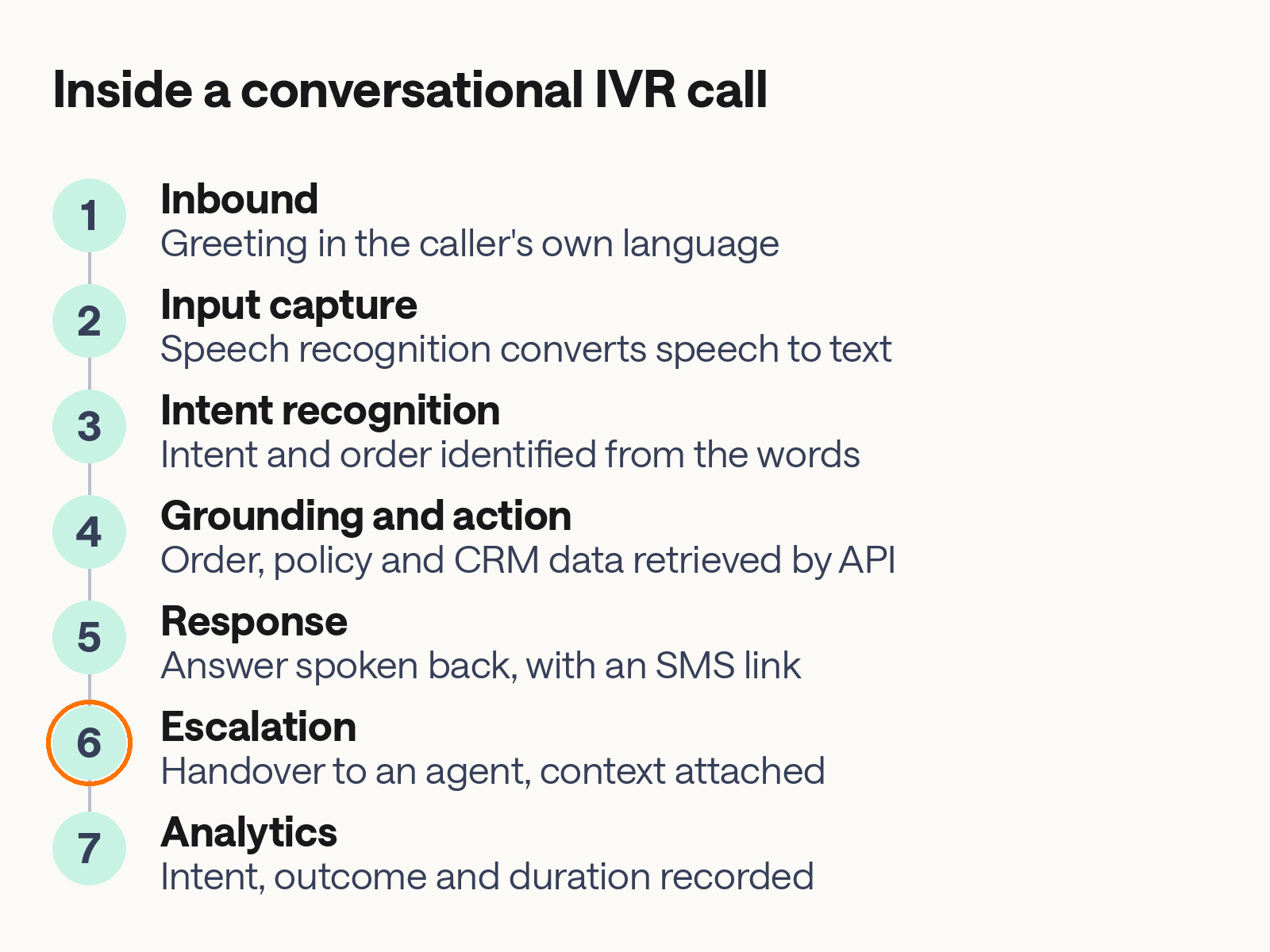
- Inbound. The call connects and the system greets the caller in Swedish, detected from the number dialed or from the caller's first words.
- Input capture. Speech recognition converts what the caller says into text in real time. The caller states a reason for calling without hearing a menu.
- Intent recognition. Natural language understanding and large language models identify the intent, which is a return, and the entity, which is a specific order. Where the input is ambiguous, the system asks a clarifying question instead of giving up and transferring.
- Grounding and action. The system queries the order management system, the returns policy, and the CRM over APIs. For a return inside the policy window, it completes the request on the call.
- Response. Text-to-speech delivers the answer in Swedish, with a return reference and an SMS link where the retailer offers one.
- Escalation. If the request falls outside policy or the caller asks for a person, the call transfers with its context attached. The agent sees the reason for the call and the data already retrieved before speaking.
- Analytics. The call produces structured data: the intent recognized, the outcome, the escalation reason, the duration, and any post-call score. That record is what you use to improve recognition and widen coverage.
The IVR Modernization Scorecard
Before you commit budget to IVR modernization, score the system you already have. The five signals below separate a phone channel that needs restructuring from one that needs replacing. Work through them with last quarter's IVR analytics open.
- Signal 1: Call abandonment above 30%. Abandonment inside the menu is the clearest evidence that callers will not engage with the system. Treat anything above 30% as a flag and anything above 45% as urgent.
- Signal 2: More than 20% of calls press 0 or ask for an agent. Every 0-press is a caller deciding the system cannot help them. High rates mean your IVR is routing rather than resolving.
- Signal 3: Fewer than three languages, but three or more European markets served. Touch-tone systems need a separate deployment per language, so your maintenance cost rises with every market you enter.
- Signal 4: IVR changes take more than three months. If policy or CX changes wait on menu restructuring, re-recording, and vendor testing, the phone channel is setting the pace for the rest of the business.
- Signal 5: Containment below 25%. A system that resolves fewer than one call in four end to end is a routing tool. A conversational self-service IVR is worth evaluating when the intents arriving on your lines are repeatable enough to resolve without a person.
| Signal | Yes | No |
|---|---|---|
| Call abandonment above 30% | ||
| More than 20% of calls press 0 or ask for an agent | ||
| Fewer than three languages across three or more markets | ||
| IVR changes take more than three months | ||
| Containment below 25% |
Three or more yes answers means the case for replacement is already made, and the question is sequencing. One or two means you have time to plan a phased upgrade against your next budget cycle. Zero means your current system is holding, and the review can wait 12 months.
Conversational IVR Use Cases for European B2C
The intents that suit voice automation share a shape: high volume, repeatable, and answerable from a system you can reach over an API. That pattern shows up in the same five sectors.
- Retail and e-commerce. Order status, delivery exceptions, and returns account for most inbound volume after a promotion or a carrier delay. The system reads live order data and carrier tracking, answers the question, and starts the return where policy allows it. Disputed damage and goodwill decisions go to an agent. The same intents drive e-commerce process automation across digital channels.
- Travel and transport. Flight status, booking changes, and check-in questions arrive in predictable patterns until disruption hits, at which point volume multiplies within minutes. A conversational system absorbs the spike without a queue, because the answers come from the same schedule and booking systems your agents use. Rebooking with compensation attached goes to a person.
- Insurance. First notice of loss is structured data collection, which voice handles well: what happened, when, where, and what was damaged. The system captures the claim, opens the case, and tells the caller what happens next. Liability, fraud indicators, and anything involving injury go straight to a claims handler.
- Banking and financial services. Balance checks, recent transactions, card blocks, and fraud-flag acknowledgments are well defined and available over APIs, which makes them strong candidates for containment. Authentication design decides how far you can go. Anything that changes a credit position or prices a product stays with a person, for the regulatory reasons set out below.
- Utilities and telecoms. Outage reporting, meter readings, billing questions, and appointment scheduling are repetitive enough to automate and spike hard during incidents. A conversational system takes an outage report in seconds and tells the next 400 callers what the engineers already know. Complaints and payment arrangements go to an agent.
Benefits of Conversational IVR
The conversational IVR benefits worth planning around are operational ones, and they follow from one change: calls that used to end in a transfer now end in an answer. Results vary with call volume, intent complexity, integration depth, and implementation quality, so treat this as the set of outcomes to measure, not a forecast.
- Fewer callers give up inside the menu. Abandonment falls because there is no menu to abandon. A caller states a reason for calling in the first 10 seconds and either gets an answer or reaches a queue with their context attached.
- More calls resolved without an agent. This is where the difference between USD 1.84 and USD 13.50 per contact applies. Containment rises where intents are well scoped and the data is reachable, and it stays flat where neither is true.
- Shorter handling on the calls that do escalate. The agent receives the intent, the account, and the data already retrieved, so the re-collection at the start of a transferred call disappears.
- Deflection to digital for long-tail requests. Some requests suit asynchronous handling better than a live call, and the system can send a WhatsApp or SMS link while the caller is still on the line.
- Lower maintenance cost. Intents change through configuration instead of re-recording and vendor tickets, which shortens the distance between a policy change and the phone channel reflecting it.
- Satisfaction holds when resolution holds. Customers rate a correct answer in under two minutes well, whoever gives it. Gartner found that 87% of customers say companies using generative AI must provide a route to a human agent, so handover design is part of the experience. Getting that right is what a better customer experience on the phone comes down to.
- A cost base that needs watching. Gartner predicts that generative AI cost per resolution will exceed USD 3 by 2030, above the cost of many offshore human agents. Scope discipline is what keeps the economics of voice automation working over time.
How to Upgrade from Traditional to Conversational IVR in 5 Steps
Ownership of this upgrade belongs to operations, not engineering. Technical help is needed at step three.
- Audit the IVR you have. Map every branch of the current menu tree and pull the call volume, the abandonment rate, and the transfer rate for each one. Rank your top 10 call reasons by volume. Everything that follows depends on this map, and most teams find branches nobody has looked at in two years.
- Set containment targets by intent. Score each intent on frequency and complexity, counting the steps, data lookups, and edge cases it needs. Automate the high-frequency, low-complexity intents first and set an explicit target for each. Leave high-complexity intents with agents, and say so in the plan so nobody measures the pilot against them.
- Connect your data sources. Identify which systems the IVR has to reach, which is often order management, CRM, an account database, and one or two carrier APIs. Confirm API access and response times before the build starts. Clean the data first, because a voice system queries it at volume and will expose every inconsistency in it.
- Pilot one language and one intent cluster. Deploy for your highest-volume intent in your primary market and run it for four to six weeks. Review transcripts weekly and fix recognition failures before you add anything. Resist the pressure to add a second market during the pilot, because the point of a pilot is a clean read.
- Measure, iterate, and expand. Agree the success metrics before go-live: containment, abandonment, escalation rate, post-call satisfaction, and cost per call. Review daily for the first two weeks and weekly after that. Add languages and intents once the pilot has met its targets, and when you evaluate conversational IVR software, ask how much of that expansion your own team can do without the vendor.
GDPR, Voice Data, and Compliance for European Contact Centers
Voice carries obligations that chat does not, and the rules changed in 2026. This is a summary for planning, not legal advice, so have your DPO or counsel review the design before go-live.
- Callers must be told they are speaking to an AI. Article 50 of the EU AI Act requires that people interacting with an AI system are informed of it, in a clear form, at the first interaction, and those obligations have applied since 2 August 2026. The European Commission's guidance on Article 50 says the exception for cases where AI use is obvious should be read in a restrictive manner. On a phone line, that means a spoken disclosure at the top of the call. Article 50 requires disclosure. It does not require a human fallback, though your customers expect one.
- Most contact center voice AI is not high-risk. Annex III captures credit scoring, and risk assessment and pricing for life and health insurance. Answering questions, routing calls, and authenticating callers in a bank or an insurer's contact center fall outside it, as does property and casualty pricing. A voice agent becomes high-risk if it performs an Annex III function itself. The Digital Omnibus on AI, Regulation (EU) 2026/1744, came into force on 27 July 2026 and moved the stand-alone high-risk obligations to 2 December 2027.
- Voice recordings are personal data, and sometimes more than that. A recording of an identifiable caller is personal data. It becomes special-category biometric data under Article 9 where the voice is processed to identify or authenticate the person, as in voiceprint verification. If you are considering voice authentication, that step needs explicit consent and a data protection impact assessment.
- Automated decisions with real consequences need a human route. GDPR Article 22 gives people the right not to be subject to decisions based solely on automated processing where those decisions have legal or similarly significant effects. Routing, status updates, and FAQ answers do not reach that bar. A voice agent that declines a claim, refuses a payment plan, or sets an individual price does, and it needs a human review path designed in.
- Know who processes the voice, and where. Your speech recognition, language model, and text-to-speech providers are sub-processors. Article 28 requires your vendor to disclose them and to tell you about changes so you can object, and the EDPB's Opinion 22/2024 says the identity of every processor and sub-processor should be available to you at all times. Ask for the current list, the processing locations, and the Chapter V transfer basis for anything outside the EEA before you sign.
Explore Conversational IVR with Kindly
The operating shift behind conversational IVR is small to describe and large to run: the phone channel stops sorting people and starts answering them. Kindly builds conversational IVR as a channel of the same AI Support Agents your team configures for chat, so the intents, the integrations, and the tone of voice carry across instead of being rebuilt for voice.
Three things matter when the deployment is European. Kindly's AI Support Agents speak more than 100 languages by default, so one deployment covers every market you serve, which is the same multilingual support that runs on chat. Kindly processes and stores authentication, conversation, and platform data in EU data centers, and offers an all-EU configuration for generative AI on request, under an ISO/IEC 27001:2022 certified information security management system. And voice and digital run as one agent instead of two vendors, with handover into your existing contact center when a call needs a person.
The scale is proven. Posten Bring uses Kindly Voice Agents as the first point of contact for customers across Norway, Sweden, and Denmark, handling more than 3,500 calls a day alongside 5,500 chat enquiries, with over 2.2 million voice calls handled since launch. Teams report 70% fewer hours spent on maintenance, simple use cases live within a day, and deployments with several integrations or markets live in one to three weeks.
Where to go next depends on what you run: AI support for transport and logistics, AI support for travel and hospitality, AI solutions for banking and finance, or AI tools for retail and eCommerce. For the longer view, our take on the future of customer service covers where the phone channel goes next. To see how conversational IVR maps onto the call flows and systems you have now, book a demo and bring your top 10 call reasons with you.
Conversational IVR FAQ
The questions operations teams ask most often when they start scoping a conversational IVR project.
What is the difference between traditional IVR and conversational IVR?

Traditional IVR moves callers through pre-recorded menus using key presses. Conversational IVR understands spoken language, so callers describe the problem in their own words and the system identifies the intent and acts on it. The practical difference shows up in containment, abandonment, and maintenance cost: a conversational system resolves more calls end to end, loses fewer callers to hang-ups, and is faster to change when a policy changes.
Is conversational IVR the same as a voice assistant?
The terms overlap, with one useful distinction. Voice assistant is the broad term for any AI-powered voice interface, including a spoken FAQ. Conversational IVR is the contact center application: it replaces a traditional IVR with conversational AI that handles routing, self-service resolution, and escalation to a live agent inside an inbound call flow.
How does conversational IVR understand what callers are saying?
Automatic speech recognition converts speech into text, and natural language understanding identifies the caller's intent and the details that go with it. The system then maps that intent to an action, which might be answering the question, retrieving a record, triggering a workflow, or transferring the call. Recognition improves over time as the models are refined against real call data from your own lines.
What types of customer requests can conversational IVR handle?
Order status, appointment scheduling, account updates, billing questions, outage reports, and password resets are the common ones. The pattern is high volume, clear intent, and a back-end system the IVR can query for the answer. Complex, sensitive, or disputed cases escalate to a live agent with the full call context attached.
How much does conversational IVR cost?
Costs vary with call volume, integration complexity, and deployment scope, and most platforms price per minute handled or per conversation, with annual enterprise agreements. The more useful question is what a resolution costs you today. Gartner's median figures of USD 1.84 for self-service and USD 13.50 for assisted channels give you a starting point, applied to your own volume and containment assumptions.
How long does it take to implement conversational IVR?
It depends on how many systems the agent has to reach and how many intents you start with. At Kindly, simple use cases go live within a day, and deployments with several integrations or markets go live in one to three weeks. Expect tuning to continue after launch as real call transcripts show where recognition and coverage need work.