Agentic AI Use Cases: 15+ Real-World Examples by Industry



Odds are there's a customer in your support queue right now asking where their order is. It's one of the most common queries consumer-facing businesses have to automate, because so many of them arrive every day. As with most agentic AI use cases, there are two ways to automate "WISMO" enquiries like these: the legacy way and the agentic way.
The legacy way is an AI that replies with your delivery policy, and the customer still doesn't know where their parcel is. The agentic way is an AI Support Agent that checks the carrier feed, finds the parcel sitting in a depot, and offers the customer a new delivery slot. That second approach is what best describes agentic AI: an AI system that plans, sources information, acts, and adapts across multi-step tasks with near-zero human input.
Most customers are starting to expect AI Support Agents to solve their problems as well as answer their questions, and organisations are investing in agentic AI customer support to keep up. Gartner expects agentic AI to resolve 80% of common customer service issues on its own by 2029, and service leaders in Gartner's latest survey raised their AI spending by 38% while their overall budgets grew by 2%.
If agentic customer support is on your list of priorities, you may be wondering where to start. These 18 agentic AI use cases, examples drawn from industries Kindly has served for more than a decade, cover banking, insurance, retail, e-commerce, and logistics. Your teams can begin with whichever one feels like the best fit, as long as it does three things: resolves the customer's request, connects to the systems that hold the data it needs, and hands over to a person when a request is beyond its scope.
Key characteristics of agentic AI
Agentic AI works towards a goal, such as completing a return, and takes the steps needed to reach it. Five qualities set it apart from earlier AI automation:
- Autonomy. The best agentic AI acts within a defined scope without asking for approval at every step.
- Planning. It breaks a goal into steps: check eligibility, generate the label, update the order.
- Tool use. Agents read from and write to live systems through APIs and databases.
- Memory. It remembers what the customer has already said, so the customer explains the problem once.
- Iteration. It gets better with feedback, and your builders speed that up through agent optimisation as part of their regular maintenance.
A simple test: if you can describe a task as "read the context, decide the next step, take it, update the system", it is a candidate for agentic AI.
Everyday agentic AI examples include turning support emails into tickets, converting form submissions into database entries, and drafting order updates from live carrier data.
Agentic AI vs. conversational AI
Conversational AI answers questions: ask it about a return, and it tells you whether the item is eligible. Agentic AI completes tasks: it starts the return, generates the label, updates the order management system, and sends the confirmation while the customer is still in the chat.
Agentic AI use cases in customer service
It makes sense to start with agentic AI in customer service, because contact volume is high and customers ask the same questions every day. Every conversation the agent resolves frees up time for your team. The five use cases below take the highest-value support use cases further, because the agent completes each task from start to finish.
1. Autonomous returns and refund processing
A customer wants to send back a jacket. The agent checks the order against the returns policy, generates the label, updates the order management system, and tells the customer when the refund will arrive. Returns management automation like this needs access to three systems: the order record, the returns policy, and the logistics provider. Because the customer already knows when to expect the money, they have no reason to contact you again about the refund. The agent passes damaged goods and late returns to a person, with the order details attached.
2. WISMO ("Where is my order?") resolution
The agent answers "where is my order?" with live data from the order system and the carrier. WISMO is a natural first use case, because the logic is predictable and it needs few integrations. Cellbes, an online fashion and home decor brand, connected its AI Support Agent to live parcel tracking through Ingrid and reports a 77% automation rate and a 96% success rate.
3. Multi-intent support resolution
Many customers raise several issues in one message, such as a return, a late delivery, and a discount code that failed at checkout. The agent works through each issue in turn and confirms it's resolved before moving on to the next. Track your repeat contact rate to see whether it's working.
4. Proactive issue resolution
The agent monitors order and delivery data, spots a delay, and tells the customer before they get in touch. On Kindly, the Nudge API lets your order and delivery systems trigger these messages, so customers see the delay notice when they visit your site.
5. Intelligent escalation and handover
Some conversations need a person. The agent passes these to the right colleague with the transcript, the customer's history, and the steps it has already taken, so your colleague can pick up where the agent left off. Customers expect this option: Gartner found that 87% of customers say companies using GenAI for service must give them a way to reach a human agent.
Agentic AI use cases in ecommerce
Lists of companies using agentic AI tend to feature big technology names, but for a retailer the biggest opportunity is in the post-purchase queue. Once an order ships, customers ask the same questions: where is it, can I change it, and how do I send it back? Agentic AI for ecommerce handles these requests from start to finish, and use cases such as cart recovery and product recommendations can also help you bring in revenue. Keep both in mind when you plan how to improve customer service in your e-commerce business.
6. End-to-end post-purchase automation
Once you've built the use cases above, one agent can handle every step after a purchase: order confirmation, shipping updates, delivery, returns, and refunds or exchanges. It's the most complete form of e-commerce process automation. Build it in stages, starting with WISMO, then returns, then everything else.
7. Cart abandonment recovery
A shopper stops at checkout, and the agent picks up the cart abandonment signal and starts a conversation to help with a sizing question, a delivery cost, or a failed payment. The Baymard Institute puts the average cart abandonment rate at 70.22% across 50 studies, and a large share of that is window shopping and price comparison. Focus the agent on shoppers who stopped because they had a question or ran into a problem.
8. Product recommendation and upsell during support
A customer writes in about a faulty charger. The agent arranges a replacement and then suggests a matching cable. Make sure the agent solves the problem first and recommends a product when it's relevant to the conversation. This is conversational commerce in practice, and it means your support channel can contribute revenue as well as resolve issues.
9. Self-service account management
Address changes, payment updates, subscription changes, and order history requests all work the same way: the agent verifies the customer's identity, makes the change, and confirms it's done. Get authentication right first, because the agent needs to know who it's talking to before it touches any personal data.
Agentic AI use cases in retail
Agentic AI in retail covers the website, the app, and the shop floor. Customers see all three as one brand, so the agent needs the same information in each channel. The agentic AI use cases in retail industry settings fall into three groups.
10. Omnichannel order management
A customer bought something online and wants to return it in store. The agent finds the order, checks that it's eligible, and creates a QR code for the returns desk. This needs one order record that both the website and the shops can read. If a return gets stuck between channels, you risk losing the customer.
11. Inventory and availability queries
"Is this in my size at my nearest store?" The agent checks live stock levels, confirms availability, and offers to reserve the item or suggests the nearest store that has it. If your stock data isn't live, the agent should tell the customer when your system last refreshed it.
12. Loyalty programme management
Questions about points, tiers, and rewards come up often and have clear answers, which makes them easy to automate. The agent checks the loyalty platform, explains the customer's balance, and redeems rewards on request.
Agentic AI use cases in insurance
Agentic AI in insurance deals with customers at stressful moments, such as after a burst pipe or a car accident, or when a claim has stalled. The processes are still repetitive, but a wrong answer does more damage, so the agent needs to answer from verified policy data and hand over to a person when a question is beyond its scope.
13. FNOL (First Notice of Loss) automation
A customer reports a claim in chat. The agent collects the first notice of loss details (date, incident type, damage, and photos), submits them to the claims system, and tells the customer what happens next. It passes injuries, disputes, and unusual claims to a claims handler, with the details already filled in.
14. Policy enquiry and coverage explanation
"Am I covered for this?" The agent checks the customer's policy, explains the relevant terms in plain language, and shows which part of the policy the answer comes from. Use templated answers for questions where the exact wording matters, and have the agent hand over to a person when an exclusion needs judgement.
15. Claims status updates
Claims status is the insurance version of WISMO, except the customer is waiting for money or a repair. The agent checks the claims system, explains the status in plain language, and escalates any claim that has gone past its expected timeline.
Agentic AI use cases in banking
Agentic AI in banking faces more regulatory demands than any other industry in this guide, and the wider agentic AI use cases in finance work under the same rules. Contact volume is high, and answers have to be right the first time. You can automate many routine banking requests, as long as you set clear criteria for when the agent hands over to a person.
16. Transaction dispute and fraud enquiry handling
A customer spots a charge they don't recognise. The agent pulls the transaction history, identifies the merchant, and checks for fraud flags, then either explains the charge or opens a dispute. It sends high-risk cases to a person for review.
17. Account and service change requests
Address updates, new beneficiaries, and card PIN changes work like account changes in e-commerce: the agent verifies the customer, makes the change, and confirms it. Credit limit requests are different, because the EU AI Act classes AI that evaluates creditworthiness as high-risk. For those, the agent collects the request and passes the decision to the bank's approved process.
18. Financial wellness and product guidance
"Which savings account should I open?" The agent reads the customer's account data and explains the options in plain language, then passes anything that counts as regulated financial advice to a human adviser.
How to identify which agentic AI use cases to prioritise
The best agentic AI use cases have two things in common: customers ask about them often, and they follow the same steps every time. Voi started by automating parking questions, one of its most common topics. It now automates 60% of its support volume and resolves 89% of parking questions.
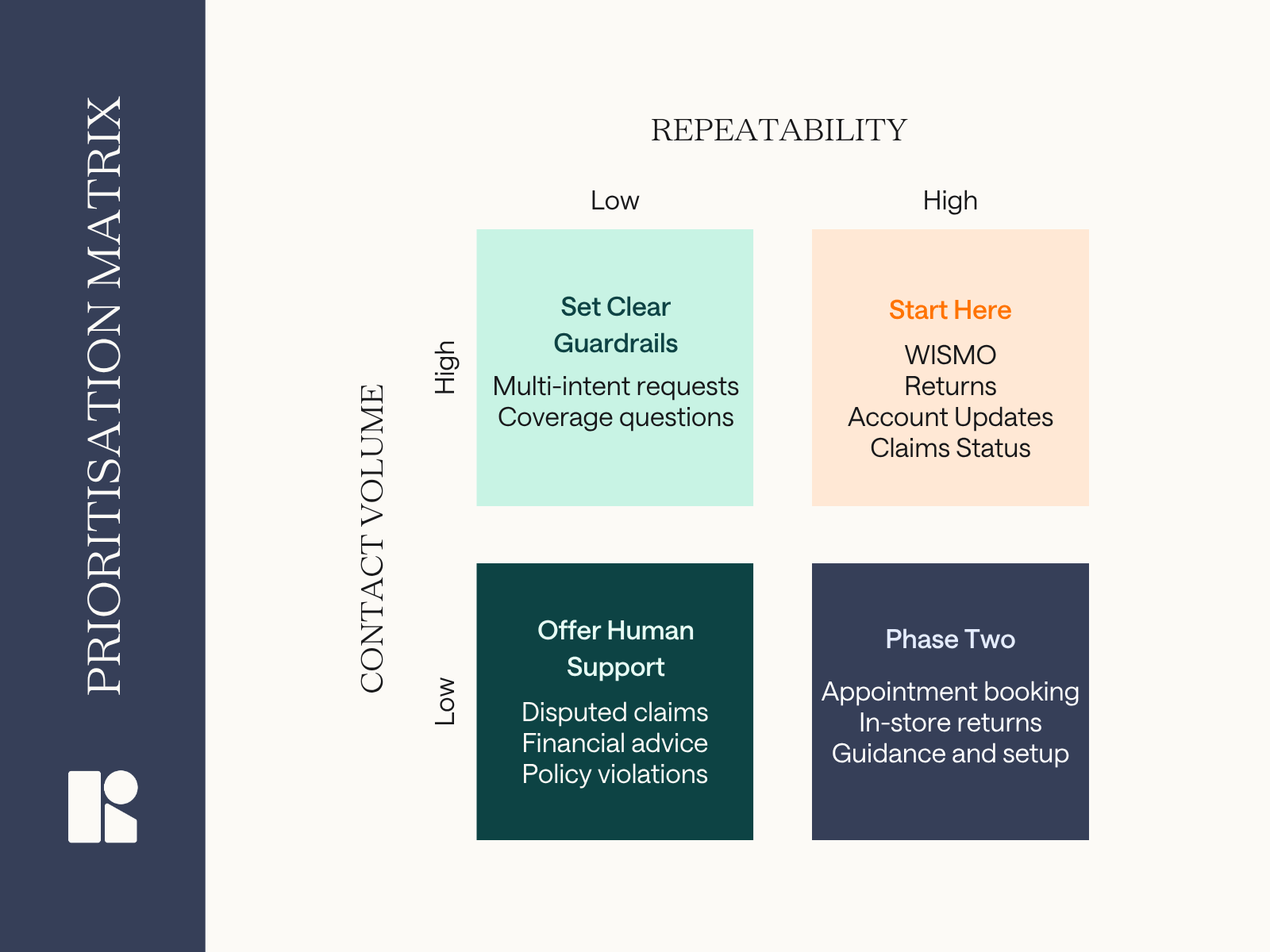
To decide where to start, work through these five questions:
- Volume. Which topics account for the most tickets? A 90% resolution rate on a topic that makes up 2% of your contacts will make little difference to your team's workload.
- Repeatability. Which requests follow the same steps every time? WISMO, returns, and account updates tend to.
- Integration readiness. Which use cases already have the data connections they need? An agent needs access to the right systems before it can act.
- Resolution impact. Where does waiting frustrate your customers most? Start there, because faster answers make the biggest difference to satisfaction.
- Risk tolerance. What happens if the agent gets it wrong? Start with low-risk requests such as order status and FAQs, then move on to refunds, claims, and account changes once the agent has proven reliable.
To answer the first two questions, look through your conversation history for the topics customers raise most and the words they use.
Agentic AI governance considerations for European enterprises
Customer-facing agentic AI applications in the EU must comply with the AI Act. Since 2 August 2026, Article 50 has required companies to make sure people know when they are talking to an AI system. The Digital Omnibus came into force on 27 July 2026 and delayed the high-risk obligations to 2 December 2027, but EU lawmakers left Article 50 unchanged.
The delayed rules still matter in financial services. Under Annex III, AI used for credit scoring, or for risk assessment and pricing in life and health insurance, counts as high-risk. AI used for claims management does not. Article 50 requires disclosure, and customers also expect to be able to reach a person, so build both into your deployment from the start.
Under GDPR's data minimisation principle, an agent should access no more personal data than the task needs. An agent answering a delivery question has no reason to open the customer's full history. You also need to know where your data is stored. Kindly processes and stores authentication, conversation, and platform data in EU data centres, and offers an all-EU configuration for generative AI on request. It also holds ISO/IEC 27001:2022 certification. You can find the details in the Trust Center.
Discover how agentic AI from Kindly moves your biggest metrics
Support teams are moving from human-in-the-loop, where the AI stops for approval at every step, to human-on-the-loop, where the AI works within set limits while people supervise it and handle the cases that need judgement. Gartner found that 85% of service leaders are giving their human agents more responsibilities as AI takes on more of the contact volume.
To supervise agents well, your team needs control over how they behave. The best agentic AI platforms let builders shape that behaviour, such as what the agent can say on each topic and when it hands over to a person. They also let builders improve the agent using real-world signals from live conversations, like the questions it couldn't answer and the conversations that ended with an unhappy customer, so your team can keep refining its agentic AI use cases after launch.
Kindly, Europe's most reliable AI Support Platform, helps teams run AI Support Agents in production. Your team builds agents that take action in your systems and check customers' identity before giving sensitive answers, and the agents respond from your own verified data, using your exact wording where it matters. Kindly logs every conversation for review and audit. In its analytics, your team can see where each agent resolves requests and where it falls short, then fix the issue in the same builder they used to create the agent. Teams on Kindly spend 70% fewer hours on maintenance, and their agents work in more than 100 languages across chat and voice.
Start with the use case that accounts for the most contacts in your volume report. Then add multi-intent handling, proactive outreach, and the use cases specific to your sector: AI agents for logistics, AI agents for banking and finance, AI customer service for e-commerce, conversational AI in hospitality, and AI solutions for utilities and services. Leave your most ambitious use case until the first one is working well.
To see how agentic AI customer support would work for your team, explore the Kindly Platform or book a demo. Bring your contact volume report, and we'll help you choose your first use case.
Agentic AI use cases FAQ
Short answers for leaders planning a first deployment.
Which industries have the most mature agentic AI use cases?

The most mature use cases are in industries with high contact volume, repetitive requests, and systems that are easy to integrate with. That means post-purchase support in e-commerce and retail, and routine requests in banking. Insurers are starting to automate claims intake and status updates, and agentic AI use cases in telecom focus on similar requests about subscriptions and billing. Agentic AI use cases in supply chain are more about monitoring exceptions behind the scenes, while healthcare is further behind because of stricter regulation.
What is the average autonomous resolution rate for agentic AI in customer service?
There isn't a reliable industry average, because the rate depends on the use case, how many systems the agent connects to, and how each organisation defines resolution. As examples, Cellbes reports a 77% automation rate, and Voi resolves 89% of parking questions with 60% of its overall volume automated. Gartner expects agentic AI to resolve 80% of common issues by 2029, but that's a forecast, not a current benchmark.
Is agentic AI the same as an AI agent?
People often use the terms interchangeably, but they mean different things. An AI agent is the software, and agentic AI describes its ability to plan, reason, and act on its own. In practice, AI agent use cases and agentic AI use cases are almost the same, and a generative AI agent is an AI agent built on a large language model.
What are the risks of deploying agentic AI in customer service?
The three main risks are:
- Hallucination: the agent says something your data doesn't support.
- Scope creep: the agent tries to handle cases it isn't built for.
- Escalation failure: the agent fails to hand over to a person when it should.
You can manage all three with a knowledge base built for AI, a tight scope, human oversight, and clear rules for escalation. Getting these right is also how customers come to trust automated support.
How long does it take to deploy agentic AI?
It depends more on how ready your integrations are than on the AI model. On Kindly, simple use cases can go live within a day, and deployments with several integrations or markets tend to launch within one to three weeks.